estimated not reported
- Reported to police
- 59.0%
- Scope
- NSW, pooled 2023–25; people aged 15+; all locations
Who is affected · NSW evidence
Police-recorded figures are a floor, not the full measure of victimisation. Recent ABS estimates indicate that 41% of physical assaults and 56.5% of face-to-face threats in NSW were not reported to police.
ABS benchmarks cover all locations. No reliable NSW bus-stop-specific under-reporting percentage was identified.
ABS Crime Victimisation 2024–25
No reliable NSW bus-stop-specific reporting percentage was identified. These recent ABS benchmarks cover all locations.
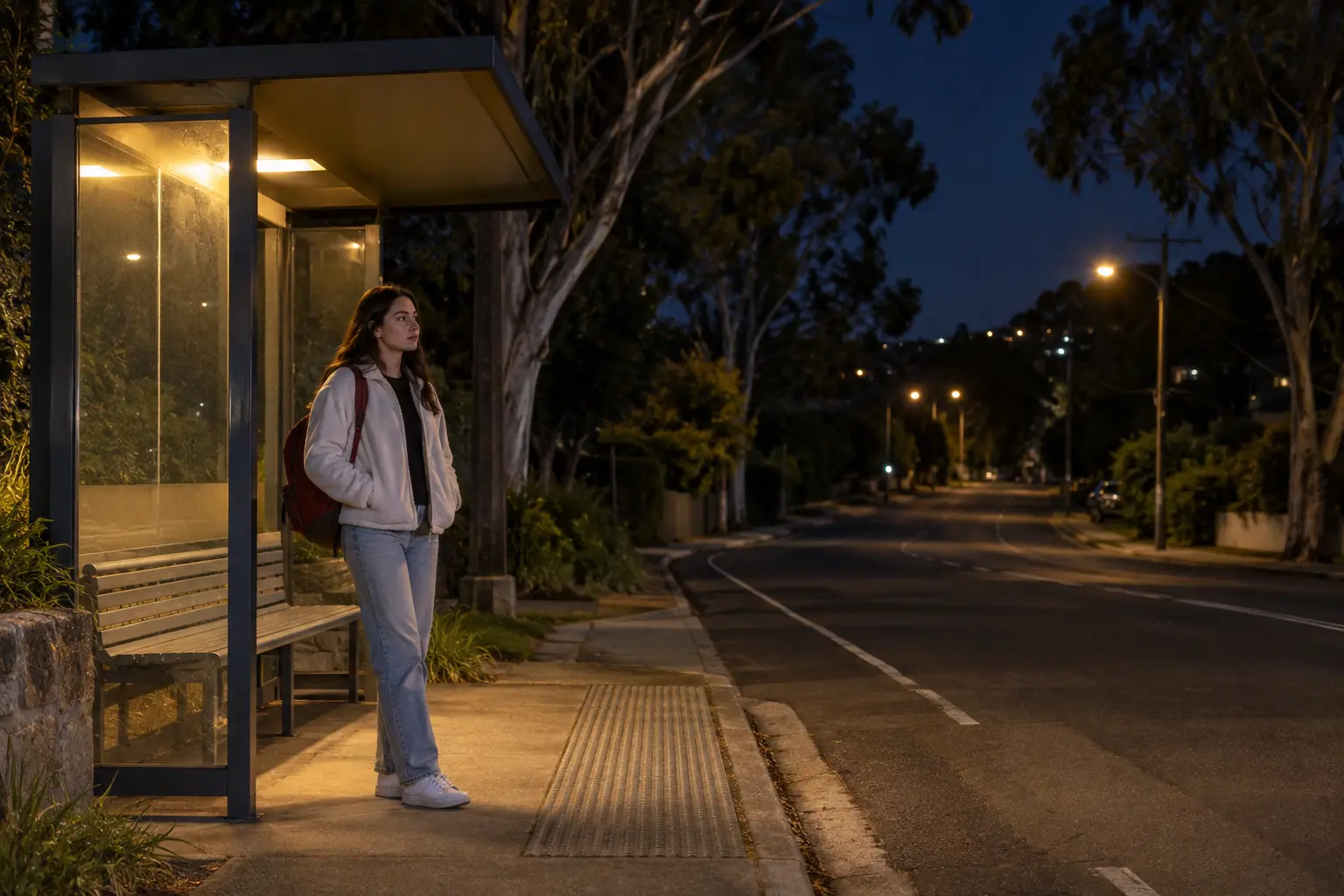
A quiet stop can feel very different when you are waiting alone after dark.
Police-recorded figures are a floor, not a full measure of victimisation. Recent ABS estimates indicate that 41% of physical assaults and 56.5% of face-to-face threats in NSW were not reported to police. Nationally, an estimated 84% of sexual assaults experienced by women were not reported. These estimates cover all locations; no reliable bus-stop-specific reporting rate was identified.
Source: ABS Crime Victimisation 2024–25
BOCSAR's category includes buses, bus depots, passenger terminals and bus stops. These are not bus-stop-only figures.
NSW recorded incidents
Annual police-recorded incident counts at NSW bus premises from July 2021 to June 2026.
| Recorded offence | 2021–22 | 2022–23 | 2023–24 | 2024–25 | 2025–26 |
|---|---|---|---|---|---|
| Assault, excluding assault police | 274 | 410 | 403 | 422 | 391 |
| Sexual offences | 58 | 98 | 84 | 63 | 89 |
| Intimidation, stalking and harassment | 118 | 169 | 164 | 143 | 148 |
| Robbery | 23 | 23 | 18 | 18 | 25 |
| Malicious damage to property | 108 | 99 | 111 | 101 | 121 |
| Offensive conduct and offensive language | 56 | 40 | 42 | 44 | 42 |
Source and method: NSW Bureau of Crime Statistics and Research, Crime Mapping Tool, filtered to NSW, incidents, bus premises and July 2021–June 2026. Counts are financial-year totals. The trend uses monthly population-adjusted rates across the full period. See the methodology guide and the public-transport workbook.
Greater Sydney comparison
Custom totals of the 14 BOCSAR SA4 regions beginning “Sydney –”. These are raw incident counts, not an official statistical trend.
| Recorded offence | 2021–22 | 2022–23 | 2023–24 | 2024–25 | 2025–26 | First-to-last change |
|---|---|---|---|---|---|---|
| Assault, excluding assault police | 184 | 273 | 294 | 281 | 293 | +59.2% |
| Sexual offences | 40 | 69 | 60 | 45 | 55 | +37.5% |
| Intimidation, stalking and harassment | 76 | 113 | 116 | 92 | 93 | +22.4% |
The first-to-last comparison is not a statistical trend test. The COVID-affected 2021–22 baseline may exaggerate the apparent increase.
Children and women
The 2025–26 profile covers assault, sexual offences, intimidation, stalking and harassment, plus robbery at NSW bus premises.
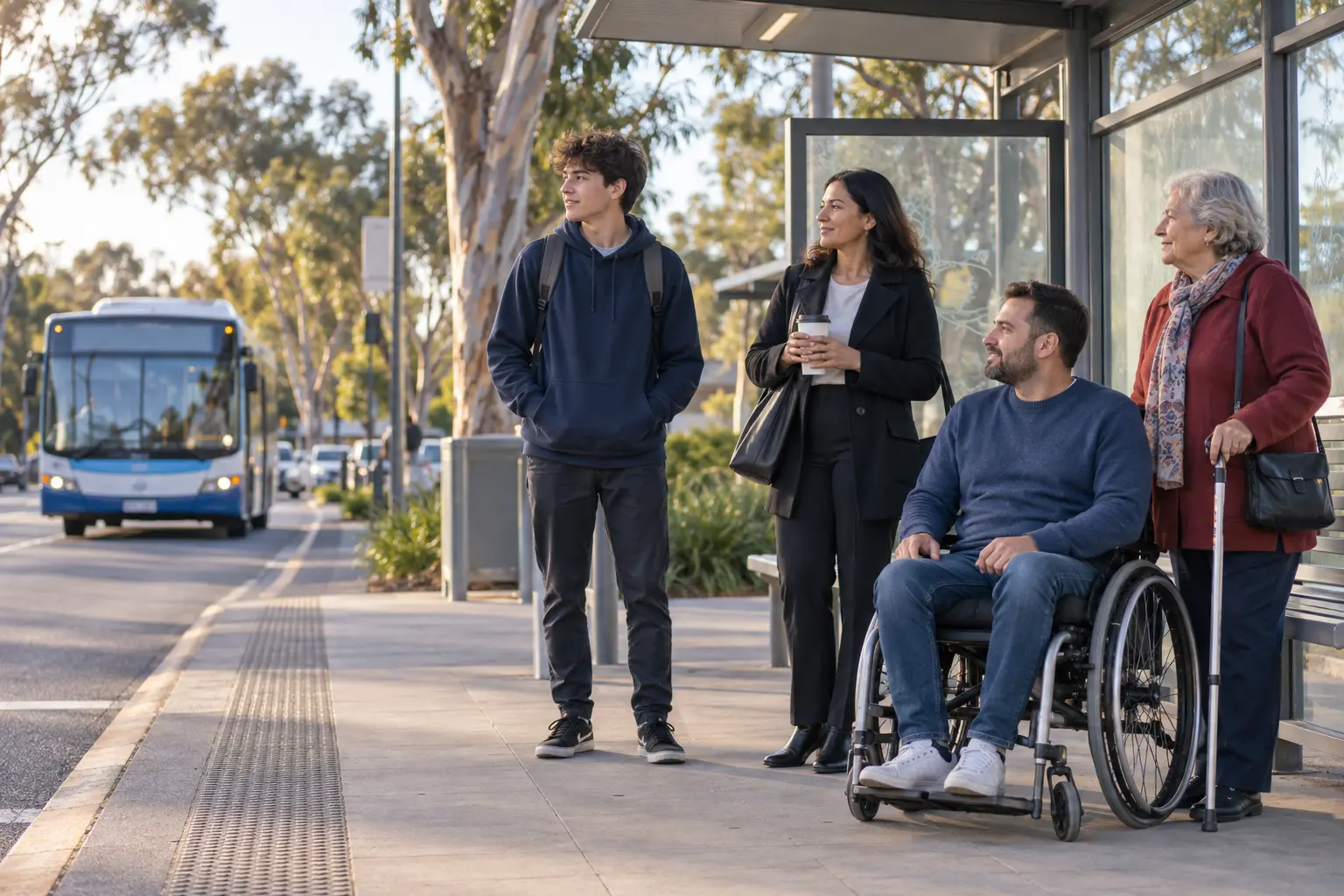
Public-transport safety matters across generations, circumstances and abilities.
Across the four selected personal-offence categories.
40.6% of the 668 recorded victim records.
47.9% of the 668 recorded victim records.
Age and gender groups overlap and must not be added together. These are police-recorded victim records—not a prevalence estimate or necessarily unique individuals. “Bus premises” remains broader than bus stops.
Women and vulnerable people
These sources add context about perceived safety and vulnerability. They cover wider settings and must not be presented as bus-stop crime trends.
Women after dark
59%Transport for NSW safety survey, 2026. Perception evidence concerning public spaces and transport-hub precincts—not a recorded-crime trend.
NSW Government sourcePeople with disability
ABS 2024–25 comparison of people with a disability or restrictive condition and people without one. All locations—not bus stops.
ABS sourceVerified public statements
No verified Police or political quotation was found that says bus stops are becoming progressively more unsafe. These statements acknowledge the problem; they are not trend evidence.
Every woman knows that feeling of clutching your keys … on the way from a bus stop or train station.
Acknowledges women’s fear on the journey to and from transport stops—not a crime-trend claim.
View sourceWe intend to use the full power of the NSW Police to continue to crackdown on violent crimes across our public transport network.
Recognises violent crime across Sydney public transport—broader than buses and bus stops.
View sourceThe community have a right to use public transport free from violent and predatory behaviour.
Addresses violence and sexual offending on the wider transport network—not a trend statement.
View sourceWider network response
NSW Police says the operation, established in 2024, targets violence and sexual offending across trains, buses, ferries, Metro services and surrounding precincts.
Recent public reports
These examples show that serious incidents occur. Individual cases do not establish a trend by themselves.
August 2023
NSW Police reported that a 16-year-old schoolgirl was assaulted and treated for multiple injuries; two alleged offenders were later dealt with or charged.
NSW Police release republished by National TribuneAugust 2025
A 19-year-old man described by support workers as vulnerable and living with disabilities was fatally stabbed; another 19-year-old survived.
ABC NewsJuly 2026
NSW Police said a 29-year-old man sustained facial injuries in an alleged assault; two women were charged.
NSW PoliceSeptember 2026
Police appealed for information after an unknown man allegedly touched a girl travelling with two other girls between Kurri Kurri and Gillieston Heights.
NSW PoliceRead the evidence responsibly
Credibility depends on keeping the claim as precise as the evidence.
Recorded assault at NSW bus premises rose at a statistically significant population-adjusted rate of 8.3% per year over the five years to June 2026.
Evidence into action
Assess schoolchild-heavy stops, busy interchanges, locations with recorded or recurring incidents, poorly lit or isolated stops and late-night routes—then fund targeted CCTV, lighting, clear sightlines and rapid evidence-preservation arrangements.